The call that started it
GarudX founder Adarsha Raj Bhusal was in Mustang on another project when the floods hit the China-Nepal border. He flew back to Kathmandu and was met with a call from the China Power engineering team and the Ministry of Home Affairs: before anyone committed personnel to the Upper Trishuli-1 hydropower tunnel in Rasuwa, a place already known to be flooded, unstable, and structurally uncertain, they needed a small drone to inspect the ground first.
The problem: GarudX's teams were already deployed elsewhere in the response, and the specific piece of equipment this mission needed didn't exist yet.
What a curved concrete tunnel does to a signal
Upper Trishuli-1's tunnel isn't a straight shot. It curves, it's lined in concrete and metal, and by that point it was partially flooded. A standard 5.8GHz FPV video feed, the same frequency GarudX's racing drones fly on, doesn't penetrate that kind of environment well. The signal needs to bend around curves and push through wet concrete and metal debris, and 5.8GHz loses too much of itself trying.
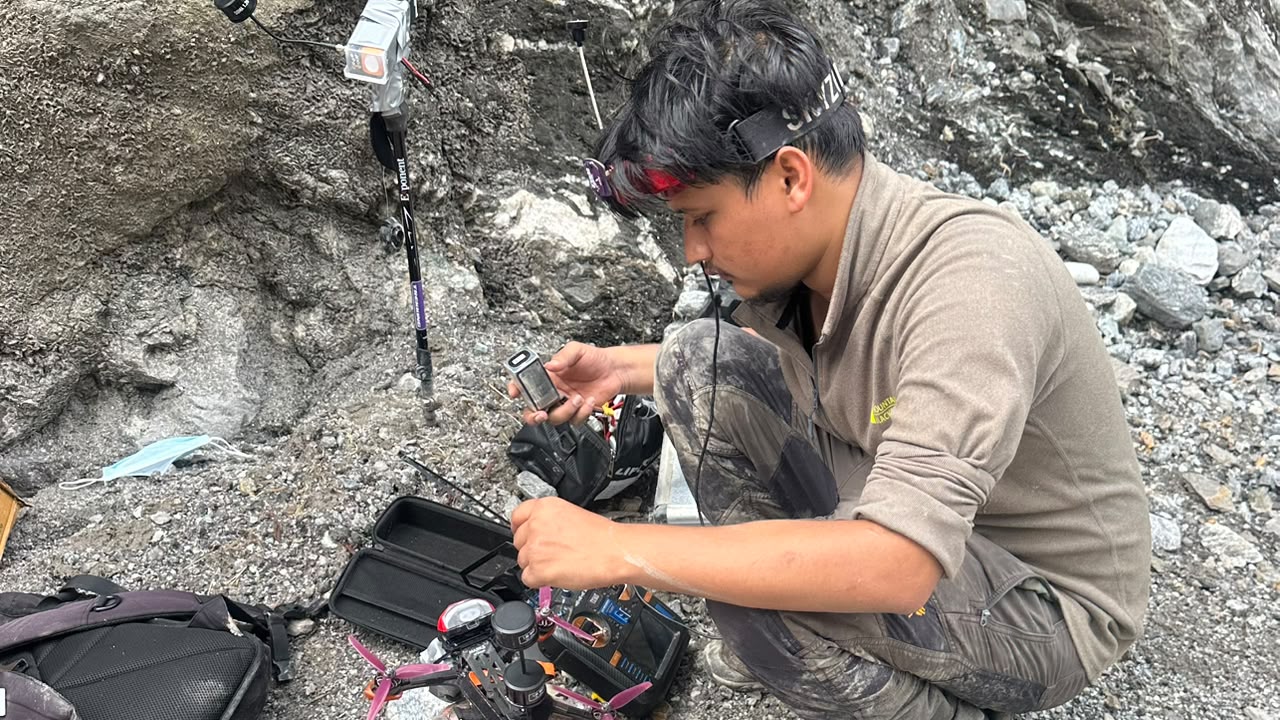
The fix is a relay: step the signal down to 1.2GHz partway through, which penetrates further and bends around obstacles better than the higher frequency can. GarudX didn't have a 1.2GHz relay module built and ready. So Bhusal built one that night, alone, mounting the 5.8-to-1.2GHz relay hardware inside a plastic box, adding a fan to manage heat, and sealing the whole thing with duct tape. He also had to waterproof the drone itself, a custom FPV airframe built by GarudX, because the tunnel had a heavy water leak and the aircraft would be flying through standing water and spray.
It worked on the first try.
3 a.m., a helicopter, and quicksand
Bhusal left for Nuwakot at 3 a.m. and boarded a helicopter alongside Nepal Army personnel and the Chinese rescue team. The helicopter couldn't land near the tunnel; the ground was mud with a quicksand-like consistency, so the aircraft had to hover while the team jumped down.
Bhusal went in waist-deep. He crawled his way out of the mud to the edge of the drop zone, then walked roughly ten minutes to reach the tunnel entrance.
The relay module itself made the final approach mounted on a trekking pole, carried in by Nepal Army special forces as far into the tunnel as they could safely go on foot. That was far enough. From there, the relay carried Bhusal's video feed back out through the curve, through the concrete, through the water, and the drone went in.
What the footage showed
The drone reached what responders were calling platform 1 of the Upper Trishuli-1 project, one of a series of large internal platforms where flood debris had accumulated. It was flooded and choked with rocks and debris. No people were visible, alive or otherwise, from what the drone could see directly.
But the water at platform 1 was bubbling, and gas was rising from it. That reading, taken together with the debris field, was enough to suspect there were bodies decaying somewhere beneath the surface, out of the drone's line of sight.
Bhusal's team briefed the government on what the footage showed. Officials ordered excavation at the site based on that briefing. The dig found bodies..
As reported
1. GarudX's role in the Upper Trishuli-1 tunnel search became international news. For the full public record:
https://www.etvbharat.com/en/videos/nepal-floods-drone-mission-rescue-workers-from-hydropower-tunnels-enn26090806843
AFP / ETV Bharat, "Nepal Floods: Drone Mission Rescue Workers From Hydropower Tunnels" — names Bhusal and GarudX directly, with him on camera.
2. The Kathmandu Post, "Drones take on a new role in Nepal's disaster response—from delivering food to carrying bodies" — names GarudX as the drone manufacturing company involved, quotes Bhusal directly on reaching platform 1.
https://kathmandupost.com/national/2026/09/01/drones-take-on-a-new-role-in-nepal-s-disaster-response-from-delivering-food-to-carrying-bodies
3. Daily Pioneer, "Drones emerge as unlikely lifeline in flood-ravaged Nepal" — same syndicated reporting, also names GarudX and quotes Bhusal.
https://dailypioneer.com/news/nepal-floods-drones-carry-dead-rescue-supplies
4. The Tribune (India), "When roads end, drones carry dead home in flood-hit Nepal" — PTI wire coverage, quotes Bhusal by name.
https://www.tribuneindia.com/news/world/when-roads-end-drones-carry-dead-home-in-flood-hit-nepal/