The line nobody saw
When the August 26 floods tore through the Trishuli and Bhote Koshi valleys, they didn't just kill and displace people. They cut lines. Roads collapsed. Bridges went with them. And with the bridges went something less visible but just as urgent: the physical lines that carry electricity, internet, and phone signal into hills and villages.
International coverage of Nepal's flood response has focused on the dramatic parts: heavy-lift drones carrying relief supplies across the Trishuli, aircraft pulled from flooded hydropower tunnels, bodies airlifted from areas rescuers couldn't reach on foot. All of that happened, and GarudX was part of it.
But there's a piece of this story that hasn't made it into any of that coverage, because it isn't dramatic to watch. It's a drone flying a thin wire across a gorge, landing, and handing it off to a ground crew. Then doing it again. And again, for weeks, on a design and a machine built entirely in Nepal.
The same airframe, built to be rewritten
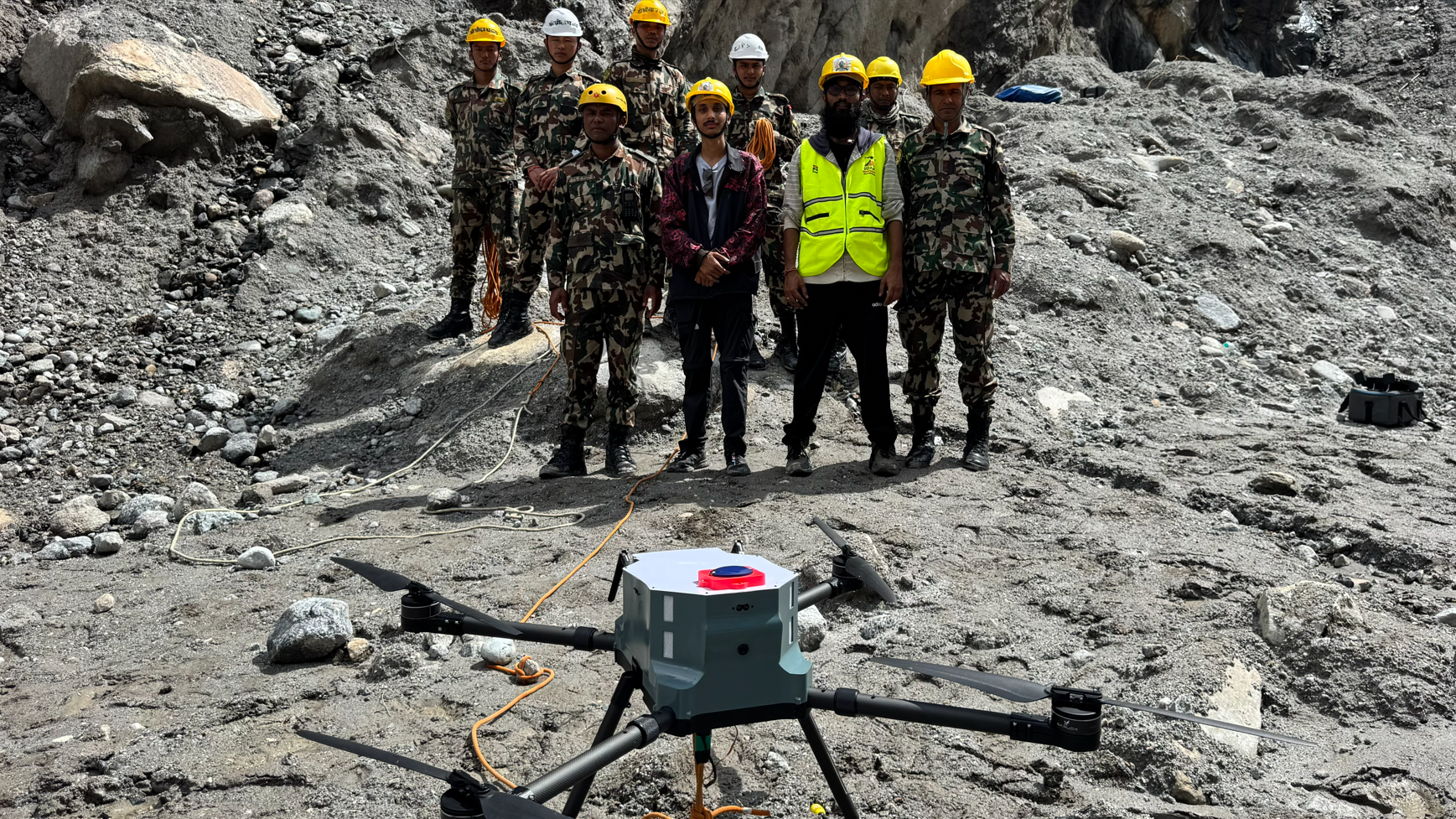
The drone doing this work is SkyReaper, the same airframe GarudX has delivered to Nepal Police for surveillance operations. But the unit in the field for this response is the payload developer kit version: a variant built specifically to be reconfigured fast, without waiting on a factory redesign.
When the flood cut communication lines into Battar, Nuwakot, GarudX's team didn't have a stringing drone sitting ready. They had SkyReaper, and they had a problem. So they modified the developer kit's payload bay with a custom dropping mechanism, in the field, to turn a surveillance platform into a stringing platform. That kind of turnaround, from "this drone watches things" to "this drone pulls infrastructure across a river," in the middle of an active disaster response, is the actual argument for why a country needs to manufacture its own drones instead of only importing finished ones. You can't modify what you don't understand down to the airframe.
How the stringing actually works
The method is simple in concept and hard in execution. SkyReaper first flies a light pilot line across the gap, whether that gap is a flooded river, a gorge, or the open span between a hydropower tunnel and the nearest road. Ground crews on the far side catch and anchor it. That thin line is then used to pull a heavier line across. That heavier line pulls the actual working cable, whether it's a communication wire, a ropeway cable, or in the ongoing NEA work, an electrical conductor.
The longest single span GarudX has completed this way is 1.3 kilometers.
Where the wire went 1. Battar, Nuwakot: two communication lines strung, restoring connectivity that the flood had severed. 2. Chilime Hydropower, tunnel access: two ropeways strung to connect the hydro tunnel, where rescue and recovery operations were ongoing, to the nearest road. Before this, moving people and machinery in and out meant helicopter runs. A ropeway does it far more efficiently, and frees up helicopters that are needed elsewhere. 3. Devighat: a communication line strung across the river to reconnect more than 150 households left with no connectivity after their bridge was destroyed. GarudX pulled the line to the internet service provider and telecom infrastructure on the far bank, restoring the link. 4. Ongoing, as of September 17: GarudX is currently stringing electricity lines in collaboration with the Nepal Electricity Authority (NEA), extending the same technique from communications and ropeways into power restoration.
Who was actually out there
This wasn't a single pilot with a drone. On the ground: founder Adarsha Raj Bhusal, COO Avaya Pokharel, CEO Avash Thapa, and pilots Aswin Khatri and Suchet. Milan Pandey of Airlift Technology supported the operation alongside GarudX's team and Saswat Rijal , Saustav Bhattrai helped us immensely in operations.
Coordinating the work above the ground level: Nepal Police, the Armed Police Force, the Nepal Army, the Ministry of Home Affairs, NDRRMA, the Prime Minister's Office, NEA, and the Ministry of Physical Infrastructure and Transport, working through continuous needs assessment with GarudX to figure out where a line needed to go next.
GarudX has done all of this voluntarily. No contract, no INGO funding, no government payment. It started on the second day of the flood and it hasn't stopped. As of today, September 17, teams are still out stringing lines.
That's worth saying plainly, not as a plea, but as a fact about what a Nepali company chose to do with a Nepali-built machine when the roads disappeared.